Pages

Monday, 22 August 2011

The Ballet Years

One of the many job titles I have been proud to wear over the years is that of Ballet Mum. (No; stop right there. I know what you are thinking – but I said ballet mum, not stage mum. Ballet mums are nice people who support their child’s desire to dance, make their costumes and take them to every rehearsal and eisteddfod. They don’t however let the dream of a famous child consume their life and are known to actually put their foot down when the ballet bill resembles the national budget of a small third world country and say enough – no more classes. They don’t get banned from eisteddfods for disputing the adjudicators’ decisions).  

It has always somewhat bemused me that my eldest daughter has been such a passionate classical ballet dancer from the time she started dancing at four years of age until went she went to university and couldn’t continue. My mother reminds me that she took me for one ballet lesson when I was a child. At the end of the class, the teacher quietly took her aside and told her not to waste her money (and quite possibly the ballet teacher’s time). Clearly my childrens' dance ability does not genetically depend on their mother.

Little budding ballerinas need ballet clothes. Ballet mums who are stay-at-home mums need to do this as cheaply as possible. (Have you seen the price of leotards and ballet shoes?) Hence I’ve knitted a number of ballet wrap jackets and leg warmers over the years. This was always partly driven by the fact that I had the only little tiny tot ballerina who refused to wear pink. (Who has their goth phase at five years old? It was minus the bad makeup though). 

Little ballerinas need their good luck charms and mascots too, to stick in the ballet bag for exam day and to take backstage at eisteddfods and concerts and to sit on the bed at night. So, I’ve also knitted a number of special ballet related toys too. This blog post is about two of these in particular.


The first is a little ballerina dolly. I don’t know if she ever got a name. The doll was based on a design by Jean Occleshaw in the June 2000 edition of Handmade magazine. Whilst the basic doll is made following this pattern, the decoration and finishing touches are quite different. The inspiration came from the second tutu I ever made which for various reasons was affectionately known as ‘the wedding dress tutu’.


The basic doll is knitted in a 5 ply machine wash on 2 ¼ mm knitting needles. Some modifications were made to the basic pattern with the removal of the neck ruff and the addition of lace appliqué on the neck of the tutu. I also modified the ballet ribbons on the ballet shoes. No self-respecting ballerina would ever tie a bow in their ribbons! The ends are tucked in and no knots are allowed to show. I also made a scale model tiara from copper wire and crystal and pearl beads.

The wedding dress tutu
Close up of lace and beading and tiara

The second is ballerina teddy. I have actually made two ballerina teddies, one for my daughter and one for her jazz teacher for Christmas. The pattern is taken from Teddy Bears: Twenty-five irresistible designs for knitted bears by Debbie Bliss.

The teddy is made from 8 ply bouclé wool. It is knitted on 2 ¾ mm knitting needles. The wrap jacket is made from 8 ply variegated yarn. The skirt is made from chiffon. The ballet shoes are knitted from a 8 ply baby nylon.
The ballerina teddy pictured in the book
Who could resist such a cute face? I prefer to use teddy eyes rather than embroidery.
Real ballet ribbons
This is the butterfly tutu. Here are the teddies at an eisteddfod.

Sunday, 7 August 2011

My Grandmother's Button Collection

My Grandmother, my Oma, was a seamstress. She made wedding dresses and party frocks for people. Before she emigrated to Australia from the Netherlands, she and my grandfather (Opa) had a factory making men's suits and during the occupation of Holland in the second world war they were forced to make German Uniforms.

She taught me how to sew. I remember as child being allowed to play in her sewing room, with scraps of sumptuous evening fabrics, satin, velvet and lace. She had a huge stack of pattern books which we browsed avidly for hours, choosing our favorite outfits to make for our dolls. She made me bathers when, as a gangly teenager, I was too skinny to buy ones that fit; my first grown up winter coat and my dress for my debut. She taught my father to sew and he hemmed the yards of full skirts and petticoat of my wedding dress.

When she died, I inherited some of her button collection. For a long time, they just rattled around in my button tin as they were mainly one off unusual or antique buttons and so not often suitable for anything I needed a button for.


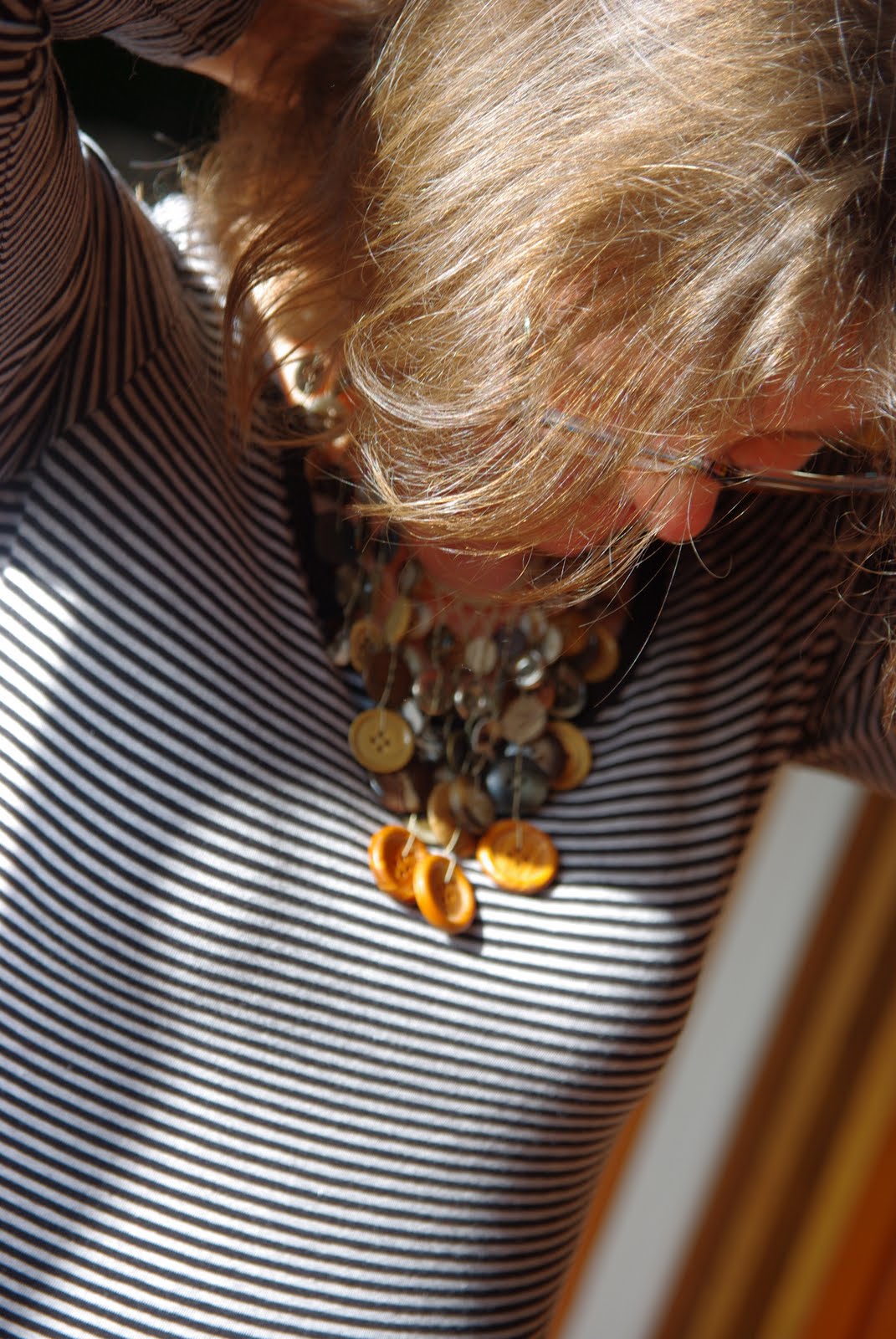
Then I found a pattern for a necklace made of buttons, using a combination of crochet and macrame. The pattern comes from the January / February 1998 Edition of Australian Women's Weekly Handmade Magazine (Volume 14, No. 1). It was designed Fay Martin who I ran into on a Victorian Crochet Guild stall at a craft market a few years later. The materials used are a DMC No. 20 crochet cotton in khaki and a 2 mm crochet hook and of course a selection of my Grandmother's buttons. The buttons are wooden, bone, shell, copper, melamine, casein and modern plastic. This was summer project, made in the caravan by the beach.


The original necklace from Handmade


Every time I wear this, I remember Oma. Its not just jewelry, its a string of living memories.

(Thanks to my eldest daughter for her photography and editing skills - she put together the montage).

Jo-ann

Sunday, 24 July 2011

The Beret Project: Chapter 1

The big acessory for Winter 2009 in Australia was the beret. They were traditional french felted with the little apple stem on top, made of soft fluffy mohair and delicately beaded, chunky crochet or knit or delicate lace knits. My girls dragged me to look at lots of them in various shops and I looked at the price tags (up to $50AUD) and thought I can do better (and it will be cheaper!). Thus was born the Beret Project.

This awesome example of Beret as accessory is from K is for Kani
(I only discovered Kani's blog when I was looking for photos for this post but I'll be back. I'd love to have her sense of style.I suggest you check it out).


Forever New


Now I'm an old school knitter; I learnt all those technical skills like knitting in the round on a set of 4 double pointed needles (dpn). So I went hunting for a pattern knitted in the round and raided my stash for some wool / yarn. I searched the vintage knitting books I had here and then the internet for free patterns. The delicate lace patterns in 4 and 5 ply appealed to me the most but I thought I try something a little less intricate as a first attempt.

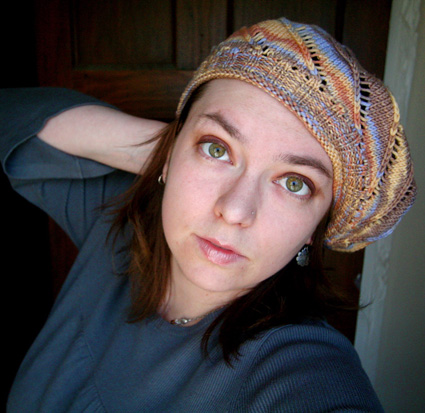
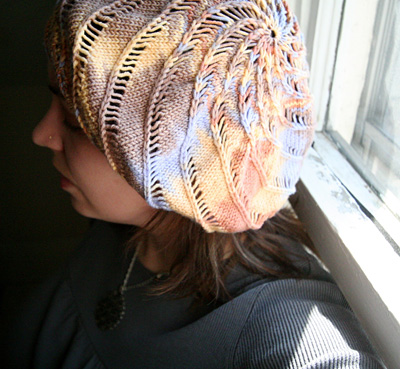
So here's what The girls and I agreed upon for the first berets. 'Reverie' a pattern by Amy M Swenson from the Spring 2009 Issue of Knitty . I'd recommend this as an ideal pattern for those wanting to try knitting a beret in the round for the first time as the pattern is simple and easy to keep track off.


The eldest daughter is a lover of all things gray / grey (pretty much her entire winter wardrobe is gray / smoke / charcoal / gunmetal or black), a great fan of the hat and dresses with that Melbourne edge I admire but never can quite pull off, so she got to be the proud owner of the first beret. I got the beret to stand still for its beauty shot but don't have a photo of her wearing it as it hard to get someone to pose for a photo when they are overseas at the moment! However, it was a great success and it is still one of those skin graft garments two winters later.

The wool is a fine 8 ply machine wash in a very pale grey marle. It was knitted on a set of US #3/3.25mm double-point needles. After knitting, the beret was thoroughly wet and blocked using a dinner plate to get the shape. (You wet the beret, place it over a dinner plate of the right size and run a scrap piece of wool as a gathering thread through the brim stitches and pull it up tight. Then leave the beret till it is completely dry remove the gathering thread and ease it off the plate. If the beret loses it shape after repeated washing and wearing, you can repeat this process again).

The other daughter, Mel, chose a fine 8 ply black mohair from the stash for her beret. It was also knitted on a set of US #3/3.25mm double-point needles.This was much less pleasant to knit (I'm slightly allergic to mohair  and while I can knit with it in small doses, I can't wear it myself).  The beret had to be pulled out and re-knit a few times as it was impossible to pick up dropped stitches as they were extremely difficult to see. I don't recommend trying to knit a lace pattern in black unless you are a patient knitter! However the result was worth it (though the pattern is not as obvious in the fuzzy wool).

So here's the black beret and Mel wearing it.


Berets are addicitive. Part of the attraction is that they are relatively quick to knit. Each of these took about a week to knit. So this was just the beginning....

To be continued....

Friday, 15 July 2011

Harry Potter: In honour of the last ever Harry Potter Movie

In Australia, the last Harry Potter Movie: Harry Potter and the Deathly Hallows Part 2 was released this week. In anticipation of seeing it this weekend, the kids had a movie watching afternoon re-watching Harry Potter and the Deathly Hallows Part 1. Harry Potter came out of storage to snuggle on the couch amongst all the blankets and food to watch his adventures.

Harry Potter.
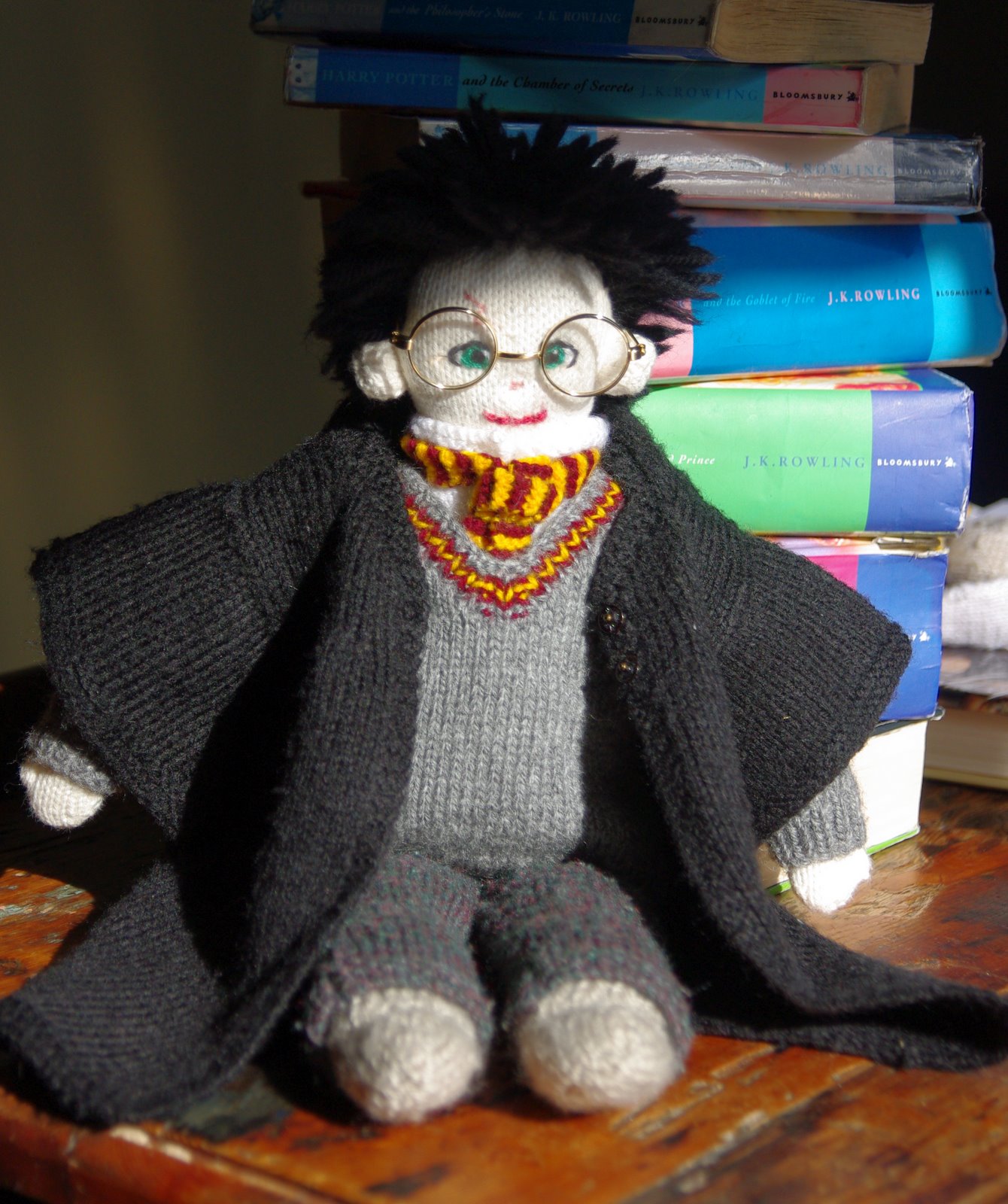
I made this for my son when the second Harry Potter Movie came out (he was about 8 at the time) and just slightly Harry Potter obsessed. Harry is knitted from 8 ply (Double Knitting) 100% cotton from Bendigo Woolen Mills. His clothes are mainly of my own design and the yarn is a variety of 8ply wools and acrylic sourced from my stash (which fills a whole cupboard!). These are actually the second pair of glasses Harry has had. The first pair were a better fit to the scale of his face (however, small boys are inherently destructive).

The basic doll was made using a pattern from the November / December 1998 edition of The Australian Women's Weekly Handmade magazine. Harry is basically built up from the pattern for Rueben.

Harry and Hedwig


Here are close ups of Harry without his glasses and his clothing.


Harry's Quidditch Robes
Hedwig is a pattern of my own design.

Hedwig